Tuesday, December 4, 2012

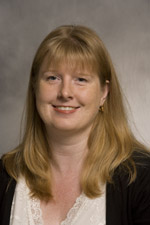
Senior Lecturer Michelle Everson on Online Discussions, News-Based Activities, and the Journal of Statistics Education

"I feel I get to know each student's voice more in the online course because I get to witness how he or she talks through different concepts and ideas and I get to witness how that changes over the course of the semester."


The latest issue of the Journal of Statistics Education features Allan Rossman's interview [PDF] with our very own Senior Lecturer, Michelle Everson! Michelle discusses her path to teaching and her growth as an online teacher and member of the statistics education community, and her ideas for the future direction of the Journal of Statistics Education as she prepares to take on the mantle of head editor.

How can we engage students with news stories? Can online environments help shy students flourish? What are ways that statistics educators can collaborate more? Michelle shares her honest and thoughtful insights from her years of award-winning teaching and designing courses.

Tuesday, November 13, 2012

Graduate Programs in Statistics Education Workshop: Planning for a Vibrant Future

  
Where will future statistics education researchers come from? The discipline now has journals and conferences, but we face a need for systematic, high quality training of a continual pipeline of statistics education researchers to create a flow of fresh perspectives that integrate with a deep understanding of what has been learned before.

Building on the successes of its 10-year-old statistics education program in the Department of Educational Psychology, the University of Minnesota hosted a Graduate Programs in Statistics Education Workshop on September 28, 2012, for other institutions looking to develop their programs, connect their research, and find opportunities for collaboration. This meeting at UMN's STEM Education Center brought together faculty already involved in planning and implementing these efforts to share their progress, consult on challenges, and form productive collaborations, and was made possible by a Member Initiated Grant from the American Statistical Association (ASA).

Xiao-Li Meng
On the first day, we heard from participants about the main issues that institutions face in implementing statistics education graduate programs. What departments should a statistics education program be affiliated with? How should the teaching and research components be balanced? How much statistics training should be involved? How should statistics education non-degree, Masters, and Ph.D. programs fit with structures in place for Mathematics or Science Education Ph.D.s? Xiao-Li Meng of Harvard University discussed the importance of preparing excellent statistics instructors, and Dennis Pearl of Ohio State University discussed how the current workshop related to guidelines [PDF] developed by a previous workshop that was endorsed by the ASA and the Consortium for the Advancement of Undergraduate Statistics Education. Joan Garfield and Michelle Everson of the University of Minnesota discussed the issues and challenges of a "Stat Ed 101" course with participants.

Dick Scheaffer, Mike Shaughnessy
The participants got to work on the second day to brainstorm next steps. Dick Scheaffer (past president of ASA) and Mike Shaughnessy (past president of the National Council of Teachers of Mathematics) set the tone by discussing the importance of statistics education graduate programs to K-12 teachers, and much of the remainder of the day was spent on small group discussions on the logistics, funding, and coursework that would be involved in non-degree, Masters, and Ph.D. programs. Dennis Pearl provided context for the discussion by providing an overview of a report that resulted from an American Statistical Association retreat on research priorities for statistics education, Connecting Research to Practice in a Culture of Assessment for Introductory College-level Statistics [PDF].

This report underscores why we need these statistics education programs to begin with: the urgent need to improve our understanding of cognitive outcomes, affective constructs, curriculum, teaching practice, teacher development, technology, and assessment in our field means we need strong institutional homes and training grounds for improving the breadth and effectiveness of the research.
Tuesday, October 30, 2012

Celebrating 10 Years of the Graduate Program in Statistics Education

So many friends came to Minnesota last month to help us celebrate the beginning of our second decade! They were from nearby, or from faraway; wise, or wet-behind the ears; and their academic affiliations showed the omnipresent variability of disciplines that inform our field -- curriculum and instruction, mathematics education, educational psychology, statistics, mathematics, and more. It was a lovely celebration, and we're quite grateful to the STEM Center at the University of Minnesota for helping us to toast the future of statistics education.

The night started with an unexpected haunting by our program's ghosts of statistics education past (Joan Garfield), present (Andy Zieffler), and future (Rebekah Isaak):

Bob delMas, who clearly has been having far too much fun on sabbatical in Australia, challenged the audience in this video to recognize as many catchy statistics education acronyms as possible... and to grapple with the thought-provoking cosmic mystery of pants:

Our supporters, friends, and colleagues who helped us get here chimed in with their reflections. Tamara Moore of the University of Minnesota STEM Center talked about her journey to understanding the relations between statistics and math education, and Michael Rodriguez discussed the healthy challenges that the program and its students bring to the university. Daniel Kaplan of Macalester College challenged us to think about the urgency of quantitative literacy for today's students. Dani Ben-Zvi of University of Haifa and Beth Chance of California Polytechnic State University shared reflections on their professional journeys in statistics education alongside Joan Garfield, while Rob Gould of UCLA dressed her up in a chef's outfit (with a little help from Photoshop). Dennis Pearl of wrapped up the speeches by discussing the importance of the work that's being done at the University of Minnesota and elsewhere to train the next generation of statistics education researchers.

To make the field sustainable, however, there needs to be more statistics education programs. That's why we also hosted a workshop on how to start more, so stay tuned to find out more about how that went.

Wednesday, September 26, 2012

CATALST Textbook

Andrew Zieffler, Joan Garfield, Robert delMas, Rebekah Isaak, Laura Le, and Laura Ziegler of Educational Psychology, have responded to concerns about high textbook prices for students enrolled in classroom sections of an undergraduate course, Basic and Applied Statistics (EPsy 3264), by producing an e-book entitled Statistical Thinking: A Simulation Approach to Modeling Uncertainty. It is available through amazon.com; the combined price of the textbook and software required for the course costs students as little as $15. (In previous semesters the textbook alone cost student $95.)

[Read the full article here]

Monday, August 13, 2012

Welcome to the Newest Catalysts for Change!

We have two new additions to the Catalysts for Change. Congratulations Laura and Laura!

Sean Ziegler
Evan Le


Both babies and moms are doing well.

Tuesday, August 7, 2012

CATALST Article Published in ZDM

ZDM–The International Journal on Mathematics Education has just published an article on the CATALST course. The article, Developing Statistical Modelers and Thinkers in an Introductory, Tertiary-Level Statistics Course, is available in the August, 2012 issue and can be accessed at http://www.springerlink.com/content/66m67055164x1ww9/?MUD=MP

Monday, August 6, 2012

Congratulations Nick, Rob, Judy and Michael!

Rob Gould, Nick Horton and Judy Singer were made Fellows of the American Statistical Association at Joint Statistics Meetings in San Diego.  Below are the brief bios and pictures that appeared in the official program.


Rob's visage is posted to the big screen as his name is called.

Also congratulations to Michael Posner, who was awarded the Waller Education Award!